
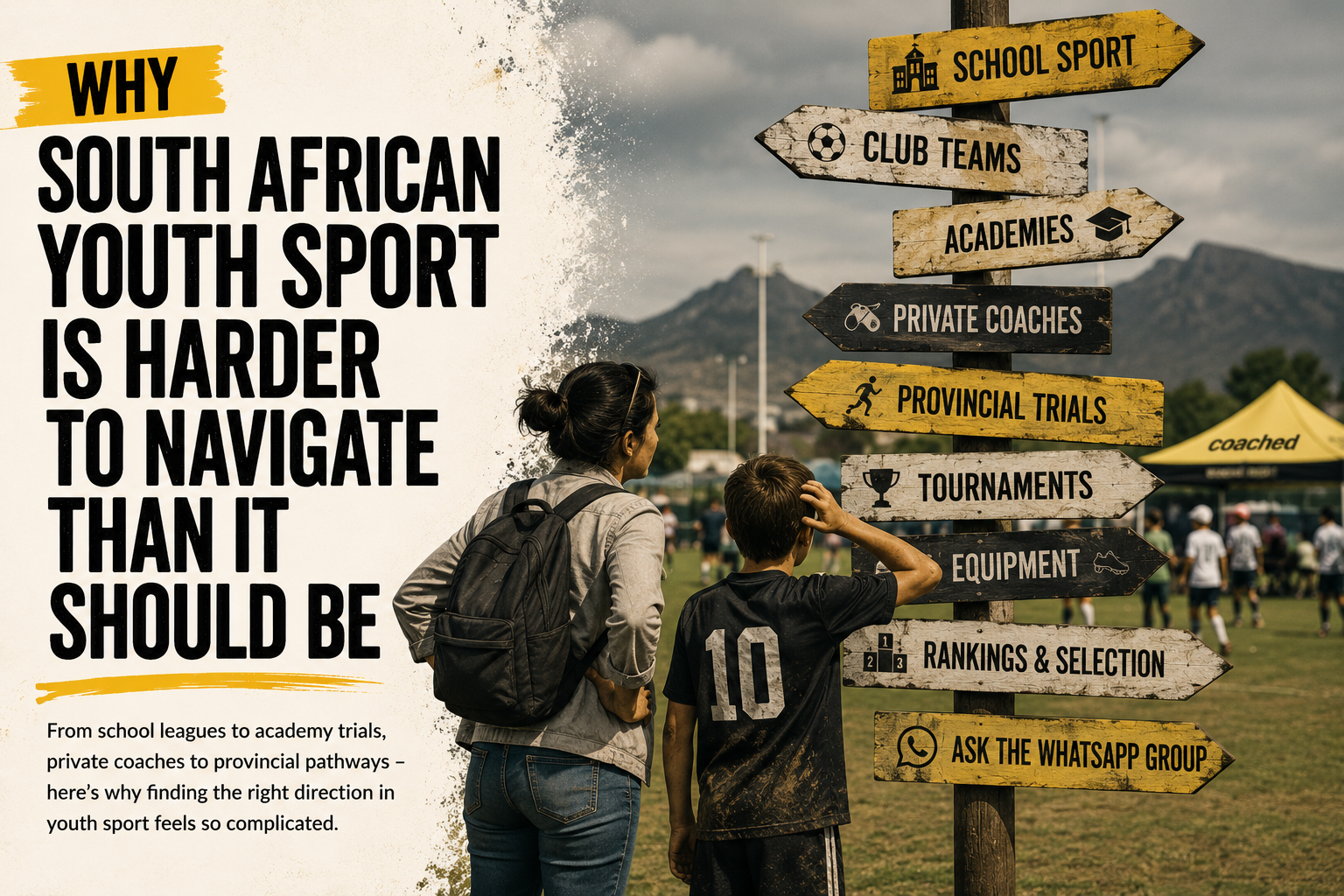
South African youth sport is full of talented children, committed coaches and ambitious parents. What it often lacks is a simple, trustworthy way to understand how everything fits together.
South African youth sport should be exciting.
A child shows promise. A parent wants to support them. A coach wants to help. A school, club or academy offers opportunities. In theory, it should all be fairly simple.
In reality, it often feels like trying to navigate a city without a map.
Parents are expected to understand the difference between school sport, club sport, private coaching, academies, trials, tournaments, provincial pathways and rankings — often with very little guidance and a lot of conflicting advice.
Everybody seems to know one part of the system.
Almost nobody seems to know the whole thing.
Everybody seems to know one part of the system. Almost nobody seems to know the whole thing.
The information lives everywhere
One of the biggest problems in youth sport is not a lack of opportunity. It is a lack of structure.
Useful information is scattered across WhatsApp groups, school newsletters, club notice boards, word of mouth, social posts and whatever one particularly organised parent happens to know.
If you want to know about trials, tournaments, good coaches, training options or equipment recommendations, you often have to ask around and hope the right person answers.
That may work if you already move in the right circles.
It is a terrible system if you are new, unsure, or simply trying to make sensible decisions for your child.
Nobody clearly explains the pathway
For many families, the hardest part is not effort. It is understanding what actually comes next.
What matters most for a young athlete?
School sport? Club competition? Private lessons? Strength work? More match play? Better equipment? Provincial trials? Less pressure? More fun?
The answer is usually: it depends.
But “it depends” is not the same as guidance.
Too many parents are left trying to piece together a pathway from random conversations and sideline opinions.
Most of the time, nobody else has the full answer either.
They are just guessing more confidently.
Quality is hard to judge
Finding a coach should be straightforward.
It usually is not.
Some coaches are excellent. Some are experienced but wrong for a particular child. Some are enthusiastic but underqualified. Some are brilliant with elite performers and poor with beginners.
From the outside, many parents have no reliable way to tell the difference.
So they fall back on:
- referrals;
- reputation;
- who seems busy;
- who has impressive branding;
- who a friend recommended;
- who trained a child who turned out well.
Sometimes that works.
Sometimes it leads to expensive guesswork.
Opportunity depends too much on who you know
A system is not truly accessible if you need inside knowledge to make it work.
Some families know which competitions matter, who the respected coaches are, which clubs are serious and when the relevant trials take place.
Other families are just as committed, but they are walking in blind.
That gap matters.
Talent should not depend on whether a parent happened to be added to the correct WhatsApp group at the right time.
Results and performances disappear too easily
This is one of the strangest parts of youth sport.
A child breaks a school record. A young athlete wins a tournament. A team produces a brilliant season. A club player goes on a serious run.
And then what?
Often, the achievement disappears into:
- a school newsletter;
- an Instagram post;
- a spreadsheet;
- a trophy cabinet;
- someone’s memory.
For a country that cares so deeply about sport, we do a surprisingly poor job of preserving the stories, performances and pathways that matter.
Sport is expensive, and the buying decisions are not simple
Youth sport is not cheap.
Parents spend money on:
- coaching;
- kit;
- tournament fees;
- travel;
- shoes;
- rackets;
- bats;
- sticks;
- physios;
- strength work;
- fuel;
- snacks;
- and occasionally their own sanity.
The problem is not only the cost.
It is that the guidance around those costs is often weak.
What should you spend on first? When does better equipment actually matter? When is private coaching worthwhile? What is genuinely useful and what is simply expensive?
There is no shortage of things to buy in sport.
There is a shortage of honest, practical guidance.
The child can get lost in the noise
This may be the most important point.
When youth sport becomes too complicated, adults start focusing on the system instead of the child.
Selections. Rankings. Travel. Programmes. Gear. Status. Progress. Other people’s opinions.
Meanwhile, the child is still trying to play, improve, compete and enjoy sport.
The purpose of youth sport should not be confusion disguised as seriousness.
It should be development.
It should be enjoyment.
It should be opportunity.
So what should change?
Youth sport in South Africa does not need more noise.
It needs more clarity.
It needs:
- easier access to trustworthy coaching;
- better organised information;
- clearer pathways for parents and athletes;
- practical guidance around equipment and development;
- better visibility on results, records and progress;
- a more joined-up view of how the system actually works.
That is part of what we want Coached to become.
Not just a place to find lessons.
A place that makes sport easier to navigate.
Because youth sport is difficult enough already.
Finding your way through it should not be the hardest part.
Trying to make sense of youth sport?
Coached is being built to make sport easier to navigate — from finding the right coach to understanding pathways, equipment and what comes next.
Comments